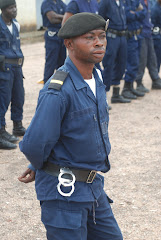
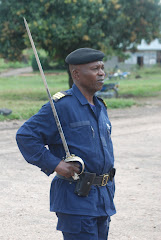
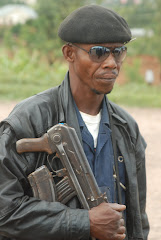
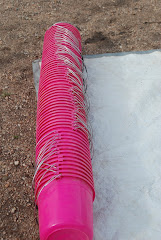
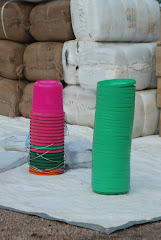
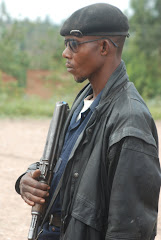
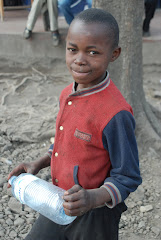
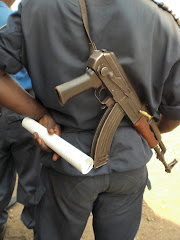
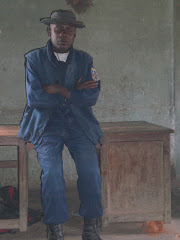
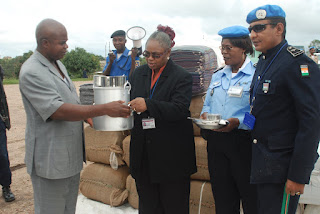
 This morning the 3rd of August, I participated in a ceremony at the PNC distibuting some well needed equipment to the police men and women. The ceremony took place on a Monday morning, at the time for their weekly parade (and head count to make sure they're all showing up for work). I have to admit that I don't know much about the police at home and their marching practice, but the Congolese police seems very military to me. Anyway, this time it was personal equipment that the police officers were given, items like blankets, buckets, pots and pans. Next thing we're working on is to update their car park. This, however much needed by the PNC, is just as much for our own purpose. According to the new SOP (standard of operations), it is from now on the PNC that is to provice escort to humanitarian missions, not the MONUC military. Thus, we need to make sure that they have the means, otherwise we're stuck in Bunia and cannot move around in the terrain.
  For quite some time, the Bangladeshi battalion in Bunia have been playing volleyboll against a team of university students. On one of these occasions, maybe at the Journée International des Casuqes Blues, the MONUC Head of Office saw them.
 Thus, she decided MONUC would do something about it.
 but it is the little things like this that gives something back to the people of the Congo and makes it all worth it!
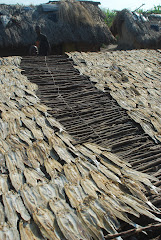
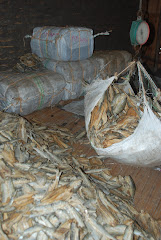
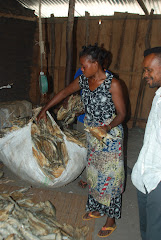
 Whenever I live or travel anywhere, the local food is one of the most important experiences for me. In Congo however, trying the local food has proven a bit difficult, not only because my house rent includes three meals a day. It's not that I don't like the food Floribert prepares (even though some spices and a bit less oil could do wonders), but I would like even more to throw myself in to the menu of foufou, plantanes, dried fish and maybe even the termites and grasshoppers.
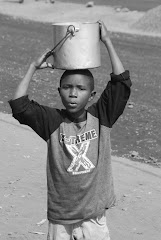
 landsproblem "I don't do any physical activities or carry heavy weights (on my head) in my daily life or at work"...'
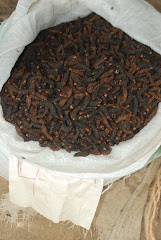
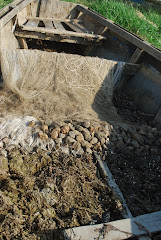
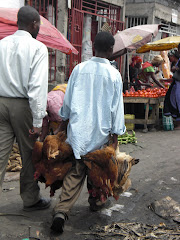
Then we have the delicacies; grasshoppers, larves and termites. When I was leaving Kinshasa for my depolyement, I had to wait for the dispatch for more than an hour. Given that it was the hour between four and five in the morning, of course I was very happy and patient... What kept me awake was the guard, colllecting grasshoppers that he jammed down an empty whisky bottle. The bottle was soon full of live grasshoppers, interesting flavour for a schnaps ey. 

I have also seen a grilled monkey, prepared whole, head, hands, fur and all. Since it kind of looked like a little baby, it was not really tempting to try. Since that was during my first days, before I worked up the courage to ask permission to take pictures, I have no proof, but I swear, it was a baby size monkey, nothing else. Rumours has it that they eat both cats and dogs, at least in Kinshasa. Apalling as it might be for me, it does keep the streets empty from wild dogs. And even though I just read that in Copenhagen a study has shown that dogs with homeless owners are the most happy dogs, I am not quite sure that applies to the dogs in DRC. Don't get me wrong, I don't necessarily think the best way to get rid of street dogs is to eat them, but it does get them of the streets after all. 

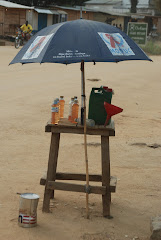
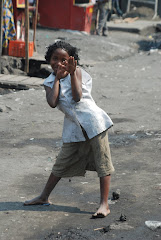
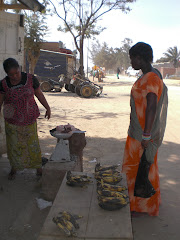
Frequent power cuts makes charcoal the most popular used sourse for heating and cooking, thus barbeques are popular not only in the south african house. Apart from meet or fish brochettes (skewers), corn, grilled to the verge of popping is really popular. They are filling and cheap and a good source of energy. Together with the sugar canes as you can see on the little girls head, they are by far the most popular snack.
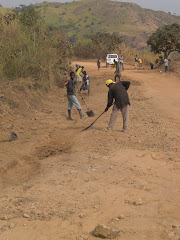
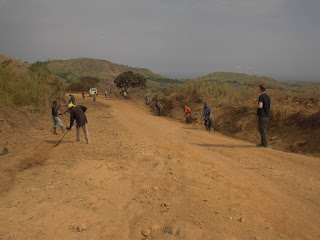
 I have a long time been thinking about a post about roads and traffic situation, or rather the lack of roads and crazy driving, in DRC. A few days ago, I came back from a mission to Bogoro and Kagaba supervising the precisely the road works. So what would be better than finally writing this post. Our work here is to monitor the work of the stabilisation plan aiming at (re)-stabilising the Congo by training and deploying police and establishing administration offices for the put in place of civil servants of all sorts. This requires rehabilitation of the roads, or sometimes building them from scratch, and building offices, police stations, and homes for the police (the last funded by Sweden). Thus, these road works are part of the stabilisation plan, and it means that finally the work started in Ituri. Pole pole, but we are moving ahead. I was happy to see women participating in the road works, however less so seeing a few being clearly less than 18 years.
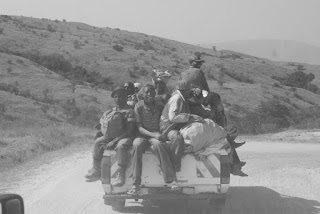 First the Nepengineers (Nepalese engineers' contingent) do the foundation work, and this we cannot monitor since the escort cannot be provided to the workers and the monitors at the same time... Thereafter, some local companies have been contracted to do the rest, and they in their turn, hire the locals to go out on the roads with hacks and spades.
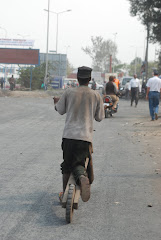
 Traffic here is as in many other countries with poor infrastructure, mostly motorbikes and some trucks, and in general much faster than both the vehicle, driver and road permits. The many many potholes help to increase the speed, but they also limits the passable part of the road making meetings a tricky business and overtaking almost impossible. Apart from stones of different sizes, the main material used is sand. Sand is not a long lasting material, and in addition to causing lots and lots of dust entering everywhere; pressed together and flattened it is also as slippery as ice. Therefore I am actually not that upset that my 4Runner has a 'speed limit' on 50 kph.
 I have actually seen traces of asphalt in Bunia, and I take this as a remain from the colonial era when this was a blooming region that at least during the two world wars had higher standard of living (for whites) than Europe.
 As always, time flies and I have now done more than half of my contract as it is for the time being. However since I am counting on an extension until the end of the year, I still have some time. Anyway, since we work 7 days a week here - always ready - we are entitled to CTO (compensatory time off) every two months. I took the opportunity to fulfil a dream I've had since school reading about Nelson Mandela, and even more since listening to him in Globen the very first time he was in Sweden, visit South Africa. In spite of the winter down there I scheduled a Western Cape/Garden Rout Tour, unfortunately just before the whale season starts. I was warned that Cape Town is like a baby, if not windy she's wet, but decided to take my chances. The warnings turned out to be true, and I was indeed happy I brought the rain coat in the very last minute. I had a very good time, travelling around with lots of nice people, eating excellent food (putting on a few kilos I'm now struggling to loose in time for Lina's wedding in August) and wine, and saw quite a few amazing thunder storms. The second week the weather calmed down though, and I managed not only to both see and visit Table Mountain, but more importantly to visit Robben Island. That was truly an amazing experience made very much alive by the fact that our guide in the prison used to be a prisoner himself. Walking around among the cells and court yards, he told us stories from his five years on Robben Island. Quite fascinating!